Created by UWE Graphic Design Students, 2026:
Emilie Persson, Joe Phillips, Josh Jones‑Bennett, Juliette Davis, Nadia Urlik, Rhys Lewis & Will Vaughan

0 / 9 DECODED
0
FAILED ATTEMPTS























Making Jargon was an arduous, eye-opening and thoroughly enjoyable process for everyone within the design team. Considering the nature of our subject matter, an omnipotent force acknowledged by all, but rarely thoroughly understood, we were keen on prioritising accessibility to the Jargon itself above all. From our perspectives; being young people, renters and students, the Financial System distinctly felt like a foreign force, controlled and manipulated by a select, often wealthy few.
When we began conceptualising the design for the publication itself, we focussed heavily on how we felt that the Financial System itself, and its corresponding Jargon, were ultimately being gatekept from the general public. A playground for the rich, toys and games strewn from wall to wall, bank notes raining down from the ceiling. Jargon leans into this chaos, reflecting the confusion and imbalances that we see within our financial system today.
For some; "It is better to have a permanent income than to be fascinating."
Oscar Wilde, The Model Millionaire.
Our finances; the savings, the balance, the budget, the anticipation of the pay cheque, the prospect of a mortgage and the rogue fiver sandwiched between sofa cushions. "In today's economy" we find ourselves tracking, assessing and scrutinising our finances to an extreme. Though the value of the pound fluctuates on an international scale, its value in day to day life seems to be on a permanent upward trajectory. Every penny accounted for. No quid, buck or smackeroo left unattended.
We are living in an age of austerity where money sits at the centre of both the issues we face, and the solutions that we pursue. The financial system that we all rely on is under strain, as the pressures of an accelerating technological shift, historically high public debt and geopolitical tensions are starting to have an effect.
Through news, politics and media, we are being constantly told how to save, where to spend, and how to 'hack the system'. EASY, INSTANT, AND HANDS OFF! But of course, it never is. Making money and keeping it seems harder than ever, and we are reminded of this fact wherever we are, whatever the time, whether we like it or not.
Amongst all of the confusion and noise, we can't forget that money is no abstract force beyond our grasp, but a system; and like any other system, it can be understood. Not just by economics graduates and financiers, bankers and politicians, but by us. The masses must come to know this Jargon, as a friend, and not merely an acquaintance whose intensity was not to our taste, in order to alleviate the pressures, and restore some balance to an inherently imbalanced system.
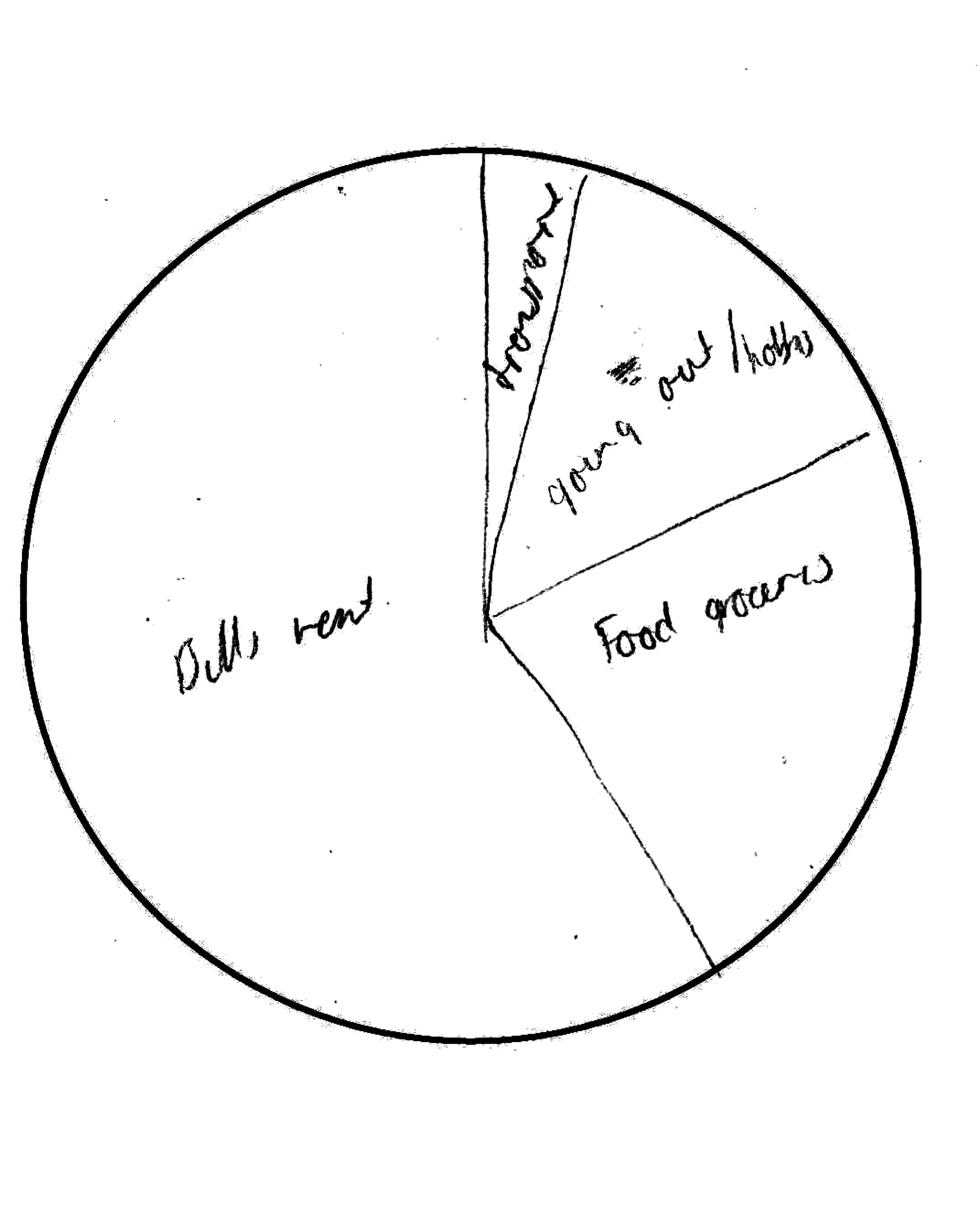
So, how did we get our greedy little hands on all this Jargon? Fraud. Embezzlement..? Though not as dramatic as these methods, opting to steer clear of any criminal activity, the Jargon team instead employed the use of workshops, interviews and general conversation to make sense of the financial system in this publication. Gathering content through workshops included distributing handouts asking for interpretations of the Jargon itself, dissections of spending habits, and financial aspirations for the future. The workshop outcomes offered the team a wide selection of honest and occasionally humorous responses and statistics, which, when paired with the professional input around the subject, offered a balanced array of content which should educate, entertain and humour the reader. Within the following pages, you will find a financial goldmine of facts, tips, explanations, explorations and definitions, with some funny bits in between.
In a world where billionaires are heralded as deific individuals with near infinite power and influence, understanding the Jargon of our financial system has become more important than ever. Knowledge is wealth, and wealth is power… right?
Over the past decades, since the late 20th century, British politics has been shaped by privatisation, deregulation, austerity, and an increasing emphasis on competition. Popularised through figures such as Margaret Thatcher, "There is no alternative" was accompanied by broader narratives such as "The Market Will regulate itself" and "we all have the same 24 hours!", which collectively re-frame structural conditions as matters of individual responsibility and inevitability. These neoliberal policies have not only restructured the economy but have also shaped how society is organised, how resources are distributed, and how value is understood. The financial system that emerges from this model operates with increasing autonomy, particularly from democratic oversight, concentrating decision-making power to the few, while remaining largely inaccessible to those it affects. The free market operates through a slow erosion of collective structures, its effects dispersed and often imperceptible, operating as an autocratic system that centres control while evading accountability, whilst maintaining an appearance of abstraction and distance, like "a giant moth eating through a coat we all share for warmth." (Michael A. McCarthy).
This inaccessibility is not only structural but linguistic. The terminology through which the financial system is described, austerity, inflation, deflation, growth, reframes political and economic decisions as neutral, technical conditions, giving the perception of inevitability, beyond our control. These processes are frequently framed as external forces, rather than the outcomes of systems that are constructed, maintained, and could be organised differently. The limited involvement of citizens in shaping these systems reinforces this sense of distance and inevitability.
Within this context, visual communication plays a crucial role. The financial system's visual language does not simply communicate information but actively produces an image of stability, rationality, and automation. Grids, modular layouts, typographic hierarchies, charts, dashboards, interface systems, neutral sans-serif typefaces and restrained colour palettes do not simply organise information; they make constructed systems appear neutral, rational and inevitable. Together, these visual and linguistic forms contribute to an appearance of authority and objectivity that masks the political and social dynamics underpinning the system.
This publication explores how power operates through financial infrastructures and how it is mediated through spoken and visual language. Through a series of conversations, workshops, and interviews, we have opened a space to question how finance is organised, who it serves, and how it might be understood differently.
Published by Typenowhere. Typenowhere is the publishing wing of the BA (Hons) Graphic Design UWE Bristol www.typenowhere.com
A special thanks to all BA(HONS) Graphic Design UWE Bristol 3rd-year students for their donations and contributions towards the creation of this publication.
- Emilie PerssonEvents & Fundraising Management & Content Creation
- Joe PhillipsIllustration
- Josh Jones-BennettEditorial
- Juliette DavisWeb Design & Development
- Nadia UlrikEditorial & Packaging
- Rhys LewisCopywriting & Visual ID
- Will VaughanEditorial
- Carolyn Sissoko
- Alice Quigley
- Susan Newman, Open University